At night Jamie climbed as high as he could.
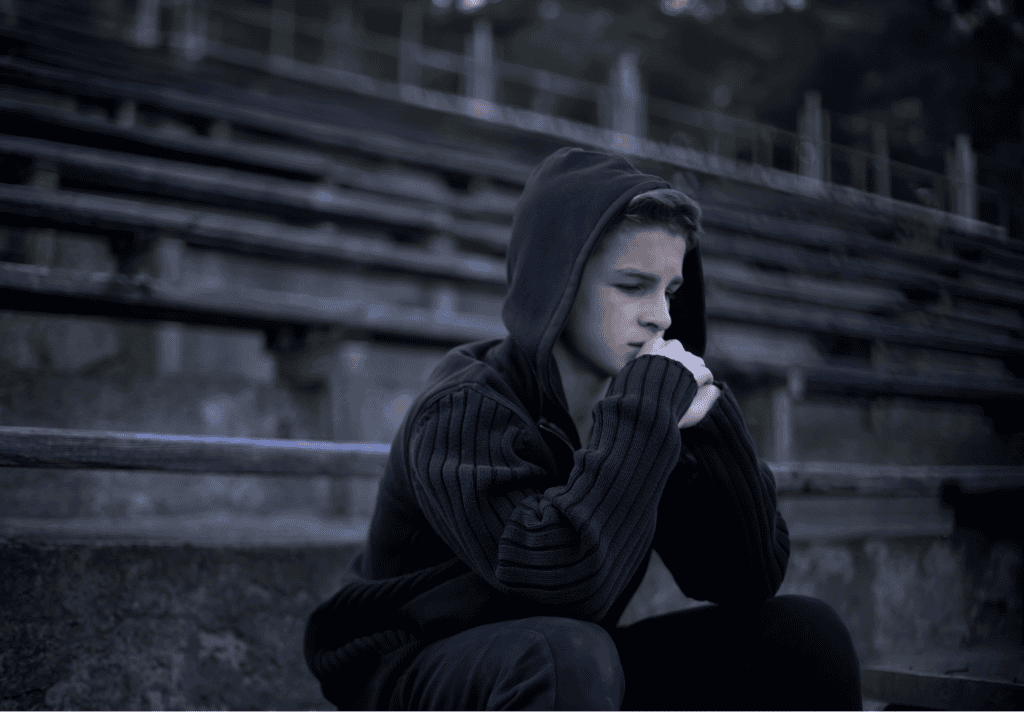
He was seventeen when we met him. Home was wherever felt safest, usually the top rows of a stadium’s bleachers to hide, the way a soldier claims the high ground. Up there he could see anyone coming. He had time to run, to hide, to decide. The height did not make him comfortable. It made him feel something he had not felt in a long time. It made him feel in control.
To understand why a teenager would choose a stadium bench over shelter or a family’s couch, it helps to understand what he had already survived. Jamie’s mother died when he was fourteen. No one taught him how to move healthy grief through a young body and mind. What followed instead was foster care, five different homes in just a few years, each one a new set of rules and a new reason to keep his guard up.
“Think of a five-year-old who has just existed through time,” said Francisco Pelayo, Fresno Mission’s Director of Youth Services, describing what he has seen in kids like Jamie.
“They find themselves older, still a kid but legally a young adult, and they have had to tap into that sink-or-swim place just to sleep and try again the next day.”
That sink-or-swim instinct is why Jamie climbed. Every decision came down to one question. How do I get to higher ground before something gets to me first?
Jamie’s story is not unusual among the youth Fresno Mission serves. Nationally, one in five who age out of foster care experience homelessness within four years, and by twenty-six, more than a third have been homeless at least once. Jamie was right on pattern.
By the time Jamie found his way to The Landing, he was not arriving because he had mapped out where his life was headed. Almost no one does. Most youth arrive as a last resort, when everything outside had gotten bad enough. The internal monologue Francisco hears most often sounds something like this:
“I don’t know where to go or who to trust. Are you safe?”
That is not a question answered with a form or a checklist. It is answered by showing up, again and again, until someone starts to believe you mean it. The exhaustion of staying constantly on guard starts to lift once a young person believes it themselves. That’s when something else moves in: Hunger. Not just the physical kind, but the kind ignored so long it almost stopped registering.
“Having a crisis response model without food is a missed opportunity,” Francisco said.
Places like First Fruits Market give youth the chance to simply shop for their own groceries, no charge, no shame. Choosing food for themselves is not something anyone ever taught them, so our staff walks alongside them and helps put together a first meal. It is a small thing, but it is often the start of real trust.
That first shared meal is never really the end goal. Sitting across a table from someone and staying while they finish is its own kind of language, one that says you belong here.
Scripture describes it the same way. Jesus does not just offer to feed the hungry. He asks to sit and eat with them. “Here I am! I stand at the door and knock. If anyone hears my voice and opens the door, I will come in and eat with that person, and they with me” (Revelation 3:20). The invitation was never just a meal. It was time spent together, and for Jamie, that first plate of food was the moment the door actually opened.
Feeding a hungry teenager is in some ways the easy part. What comes after is harder: untangling the wiring a childhood like Jamie’s leaves behind. Years of instability teach a young brain that safety is temporary and trust is a liability. Undoing that takes people willing to sit with someone through the mental load and keep showing up anyway.
That part is slow. Some youth struggle to stay because we are asking something never asked of them before. To be vulnerable. To trust people they just met. Our staff and case managers celebrate every small victory, because we are in this for the long haul.