A year ago, Randy* was onboarded for short-term work experience at JD Food, connected through Fresno Mission’s Career Pathways program. The idea was simple: use temporary work as a stepping stone, with the hope that once the assignment ended, Randy could move into full-time employment, either at Fresno Mission or through another connected employer.
Randy showed up ready to work. He was hardworking, grateful for the opportunity, and consistent in the job in front of him. His success opened a door for someone else: Jose*, who followed the same path through Fresno Mission’s vocational partnerships. Jose is now in his second week as full-time staff, the second person to move through this pipeline and into lasting employment.
“There’s a story here about a local business that shares our mission, and how they became part of the work too,” said Kimiko Petersen, Director of Career Pathways at Fresno Mission. “There are a lot of intricacies that really help equip people for economic stability, and we see a lot of progression in their journeys as we teach them core skills along the way.”
Randy and Jose are two of the first success stories to come out of Fresno Mission’s vocational education program, which has only been running since October of last year. In that short time, it’s grown into a structured system offering residents training and certification across a wide range of technical skills: auto, commercial kitchen operations, e-commerce, food warehouse, forklift operation, grounds and facilities, landscaping, administrative and office support, recycling, and other warehouse-related skills. Each track offers three levels of certification, and residents are assessed on specific technical skills at every level so they can succeed once outside the Mission.
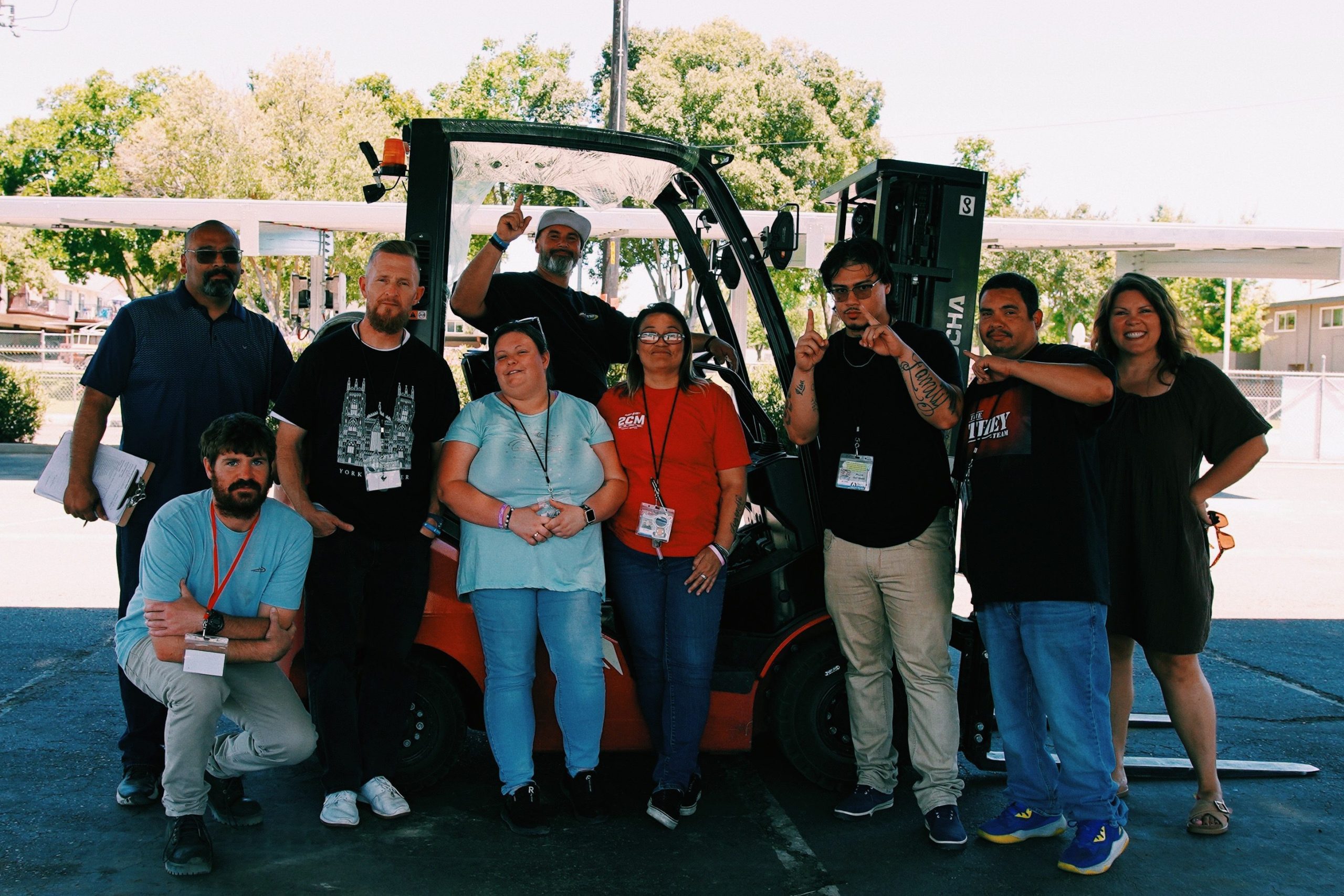
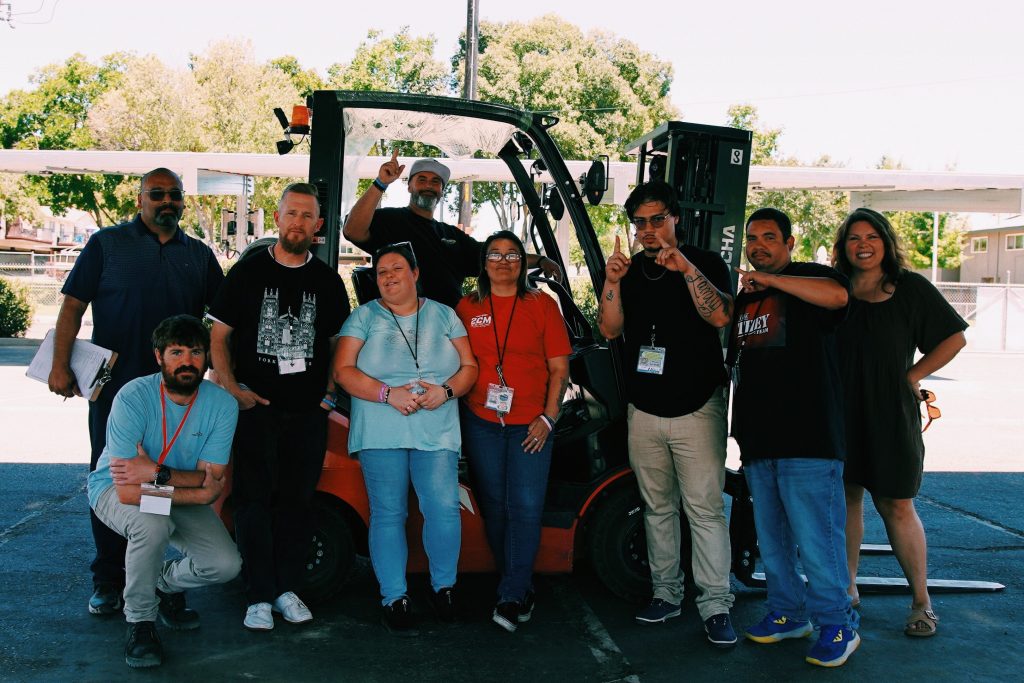
Forklift certification has become one of the program’s strongest pipelines into employment. The warehouse industry is a major part of the Central Valley economy, and a forklift certification can translate into entry-level jobs across dozens of local employers. Residents at Searcy Center complete their certification at the end of their sophomore quarter, trained a certified instructor at Searcy. While Pat leads the training, students travel to City Center to complete classwork and get hands-on practice on the forklifts themselves.
That trip to City Center means something beyond the certification itself. “We’re building exposure with them here, because we’re with them at Searcy, but then they get to see more of what we do at City Center,” Kimiko said. “The hope is that when they leave, they know they can always come back here and have this available to them.” One student, after receiving their forklifting certificate through our City Center, told Kimiko, “I’m never gonna forget this day for the rest of my life.” He talked about how much he appreciated the opportunities the mission gave him to grow, and how there seemed to be something new, every day, that could benefit his life.
That certificate carries weight far beyond the paper it’s printed on. Wherever a graduate ends up working, that employer will still need to certify them on-site, but having already earned the credential builds real confidence and gives residents something concrete for their resume, an inroad into employment they didn’t have before.
Career Pathways is about more than vocational training. Alongside its technical certificate tracks, the program supports residents pursuing a high school diploma or GED, financial literacy, computer literacy, English as a Second Language (ESL), resume writing and interview readiness, and career exploration courses. None of this happens alone. Fresno Mission partners with organizations across the Valley to make it possible, including Chawanakee Adult School, FFB Bank, Bank of America, Clovis Adult School, Quiq Labs, and the Chalmers Center, Fresno Pacific University, Central California Food Bank, JD Food, Wayfinders at Fresno State University, and Central Valley Regional Center, a partnership that also allows the program to serve adults with developmental disabilities.
Between January 1 and June 30 of this year, residents logged 2,888 hours of vocational training and 1,357 hours in classes and workshops. Last year, Fresno Mission hired 33 people directly out of its own programs, a reminder that the mission isn’t just running programs; it’s creating jobs too.
The barriers many residents face are real. About half of the population Career Pathways serves doesn’t have a high school diploma, which can make even entry-level work harder to hold onto or grow within over time. That’s why the program is built as a progression, not a single step: the longer someone stays connected to Fresno Mission, the more equipped, and more confident, they become for whatever comes next.
“When people donate to the mission, they’re not just investing in someone’s immediate needs,” Kimiko said. “They’re investing in their future too. We’re always building new partnerships and opportunities to better prepare people for independence, for life, and for kingdom purpose.”
*Names changed for privacy.