
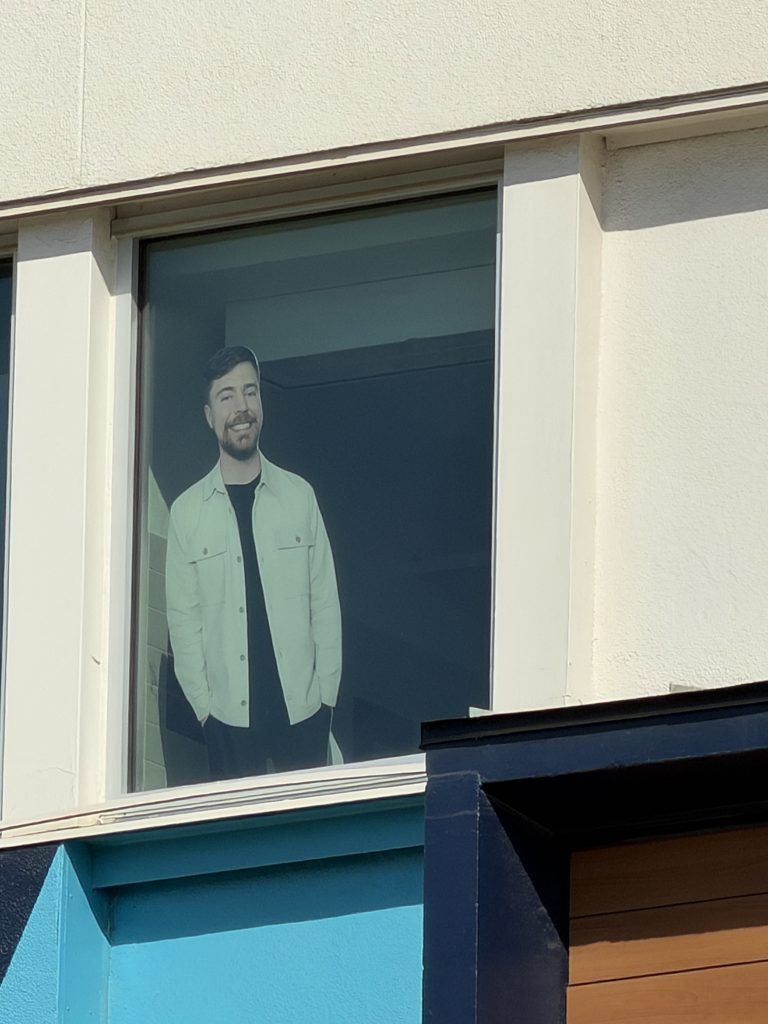
Since Conversations on a Bench, one question keeps coming up: Did MrBeast show up?
We invited him, and we’d still love to have him, but the question has made us think hard about who that invitation was really for.
A note from the author: This question even came from my own 5-year-old daughter, who wanted to know, very seriously, whether MrBeast had come to sit on the bench. Her question stuck with me. This story is my answer to her.
58% of the people we serve and feed through the Fresno Mission are children under the age of 18.
Conversations on a Bench was created to get people talking openly about homelessness, and to remind anyone in crisis that they are not alone. No one needs that reminder more than a child.
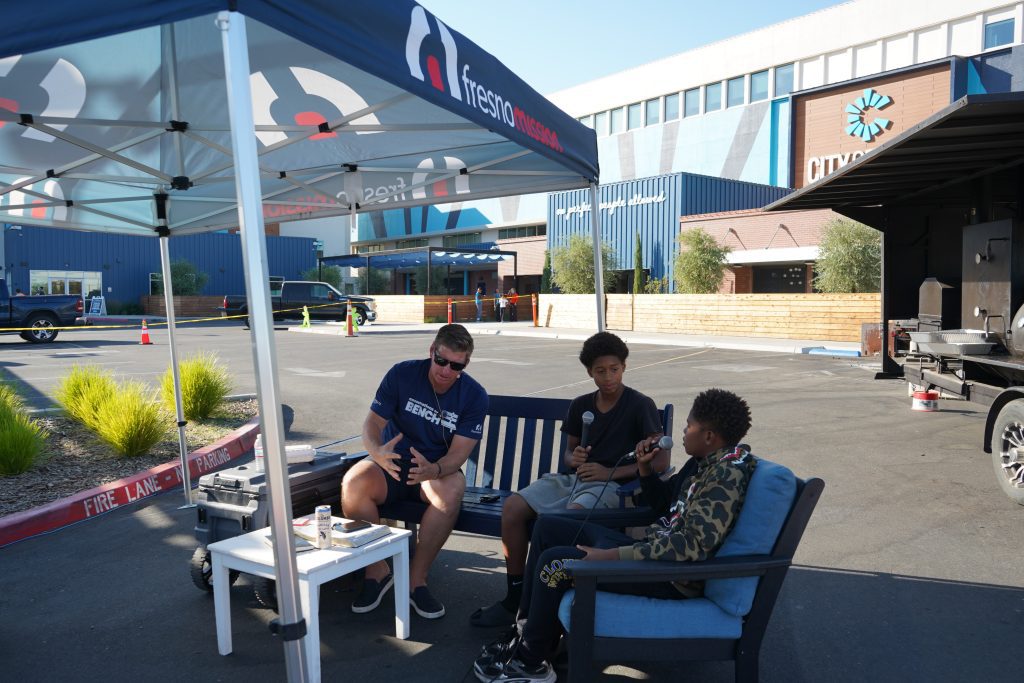
So while the world was watching for a celebrity, the guests who mattered most were already here. Over those 24 hours, two of them, ages 14 and 12, walked up and sat down with our CEO, Matt Dildine.
A Dinosaur Named Georgie
The boys met playing football at City Center. They come back to play football and basketball, and one of them told Matt, during Conversations on a Bench event, that half his friends are people he met there.
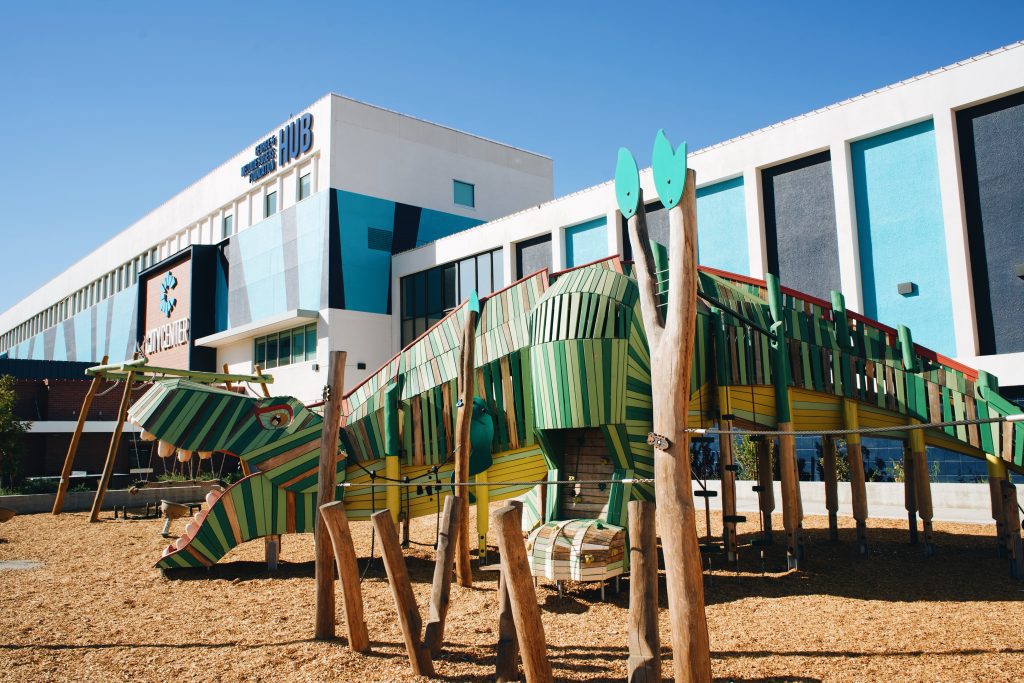
It all started with a dinosaur. One of the boys remembered walking by and spotting something enormous: Georgie, the 14-foot-tall, 30-foot-wide dinosaur at the heart of City Center’s playground. “I’m like, oh, what is this place?” he said. Georgie was the first thing he climbed inside. Then he recalls finding the swings and his brother pushed him.
That’s exactly what Georgie was built to do. “Some kids are going to be here because they’ve been sleeping in cars,” Matt told them. “I wanted to make Georgie so that if they drove up to live at a shelter, instead of thinking, is this place scary, they’d think, oh cool, there’s a giant dinosaur!”
The boys wanted to know where the idea came from. Matt told them about working with his friend Oscar, who built Martin Park, in a neighborhood where kids only had dirt fields to play on. Matt’s own kids in Clovis had big, beautiful parks, and that didn’t seem fair. “Just because you need help doesn’t mean you should get things that are bad,” he said. Kids especially need safe, great places to go, not something generic that looks like a hospital.
The boys noticed the difference. Most shelters, they said, offer food and housing and that’s it. “But y’all have a soccer field and a dinosaur,” one said. “Y’all make people want to live here.”
Then Matt asked them a question: if kids like you come here just because it’s a cool place to play, what does that mean for the kid who has to live here? We hope it makes them feel better, he explained. “This isn’t a place for people whose life didn’t go the way they wanted. It’s a place to make friends and a place for fun memories.”
Homeless youth don’t hit rock bottom. They live there.
Today, City Center serves adults and young children who come with their parents. Though one group is still falling through the cracks and that’s young people who arrive on their own, with no parent or no support system.
Matt told the boys what comes next: the Spees House, a four-story home built just for youth. We don’t want to give young people a facility. We want to give them a house, with a worship center, a gym, a game room, an esports lab, an art therapy studio, a music room, a kitchen, a relaxation room, a free clothing store, a compassion laundry center with mailboxes, and offices for partner organizations, all under one roof. The Spees House will be the most remarkable place in the country for a young person in crisis.
And it matters far beyond its walls because the number one way to reduce adult homelessness is to stop youth homelessness first.
So, Did He Show Up?
Not this time. But a 14-year-old and a 12-year-old did, and in a few minutes on a bench they summed up this work better than we ever could: You make people want to live here.
The invitation is still open, and now it’s open to you.
Help us build the Spees House so the next young person who arrives alone finds a home, not a facility.